

AI readiness
Why AI Skips Over Your Business (And How to Fix It Fast)
 By Clara MatonhodzePublished

When a client comes to me frustrated that their organization isn’t showing up in AI searches, my first question is always: “Who are you on the internet?”
Not who you are in your community. Not the relationships you’ve built or the lives you’ve changed, but who does AI verify you are?
That distinction matters more than most mission-driven organizations realize or want to accept because they think it comes with another price tag.
I learned this firsthand with The MCS Agency. We operate across borders, yet AI search still overlooks us for basic Cincinnati queries. My first reaction was pure offense. But the truth was simple: our signals and the search intent were completely misaligned. The work was there. The visibility wasn’t.
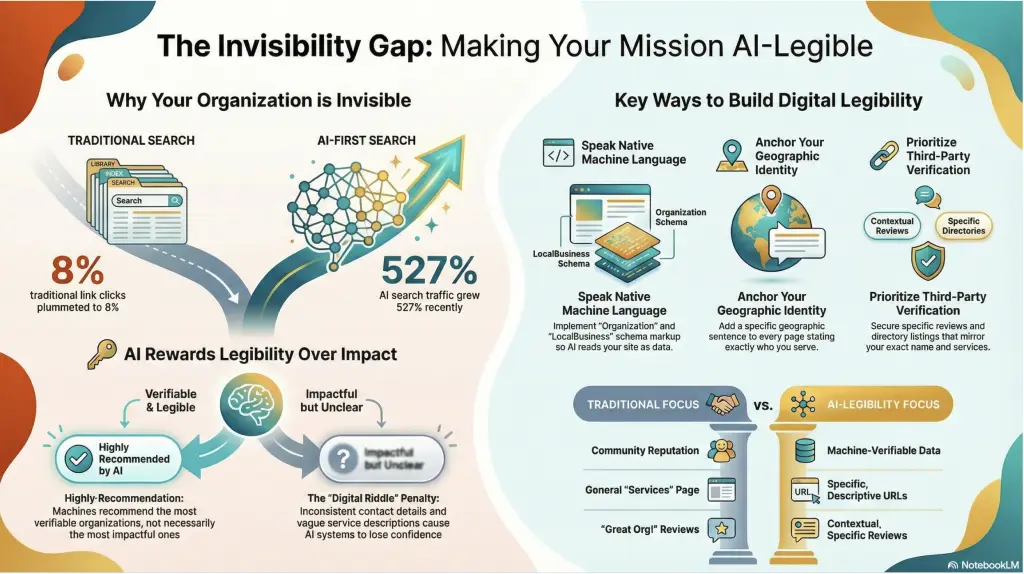
Here’s the thing about AI. It doesn’t reward the most impactful organization. It recommends the most legible one.
What’s Actually Happening
According to the 2025 Previsible AI Traffic Report, AI search traffic grew 527% in a single year. Nearly two-thirds of marketers now prioritize generative SEO. Some businesses are already seeing over 1% of their website traffic come directly from platforms such as ChatGPT, Perplexity, and Microsoft Copilot.
And when AI overviews appear in Google results, users click traditional links only 8% of the time.
If AI can’t find you, verify you, and confidently recommend you, your audience will never know you exist.
For nonprofits running on lean budgets and smaller teams, that invisibility has real consequences.
Four Reasons You're Being Overlooked
Your digital presence reads like a riddle. If your name, services, location, and contact information shift from page to page, AI systems quietly move on. They need consistency to build confidence in who you are. When your signals contradict each other, you don’t get a second look.
Your positioning doesn’t match what people are searching for. Someone searching “food pantry Northern Kentucky” wants local help, right now. If your site doesn’t clearly name your geography and your services, AI won’t connect you to that search, no matter how good your work is.
List-style content is crowding you out. Directories and “Top 10” roundups account for 34% of all citations AI pulls from. If you’re not on those pages, you’re invisible exactly where AI goes looking for recommendations.
You haven’t built enough third-party trust signals yet. Reviews, backlinks, and external mentions tell AI systems that others vouch for you. Without them, even excellent organizations get buried under competitors who have done this groundwork.
Ten Things You Can Do Right Now
- Start by adding one sentence to every page that describes where you're based and who you serve. Something like: "Based in Cincinnati, serving communities across the region and beyond." That single line gives AI systems the geographic anchor they need.
- Create separate pages for different audiences and service areas. Don't make AI guess. If you serve locally and nationally, build content that speaks to each context clearly.
- Clean up your page titles and URLs so they actually describe what you do. "Services" tells a search engine nothing. "Food Security Programs in Maryland" tells it everything.
- Turn your Contact page into your credibility anchor. One consistent name, address or service area, phone number, and email. Every platform should mirror these exact details.
- Update your Google Business Profile completely. Categories, services, hours, photos. Make it current. Make it complete.
- Add structured data to your website. Organization and LocalBusiness schema markup is the language AI systems speak natively. It's what lets them read your details like a fact sheet rather than guessing from context.
- Publish at least three case studies with specific, measurable results. "Increased volunteer retention by 40% through a targeted storytelling campaign" is infinitely more useful to AI, and to your next donor, than "we helped a local nonprofit."
- Ask clients and community partners to leave reviews that mention the specific work you did together. Context in reviews carries weight. "The MCS Agency helped us feed 200 families during the holiday season" is a signal. "Great organization!" is noise.
- Add an FAQ section drawn from real conversations with your clients and community. AI loves this format because it can extract and cite it easily.
- Get listed on trusted directories in your sector, and keep every detail identical across all of them. Consistency is the foundation of credibility, online and off.
The Bottom Line
Ubuntu teaches us that we exist in relationship. “I am because we are.” In many ways, AI visibility works the same way. Your organization is seen when enough trusted sources, platforms, and community voices confirm that you exist, deliver, and belong in the conversation.
You don’t have to be the loudest. You just have to be unmistakably clear about who you are and who you serve.
Don’t Let Discoverability Be Your Destiny
AI doesn’t recommend the most impactful organizations. It recommends the ones it can find, verify, and trust. Right now, there’s a gap between the work you’re doing and the story the internet tells about you. And that gap is costing you donors, partners, and visibility you’ve already earned.
The Mission Ready AI Field Guide fills that gap.
Inside, you’ll find the exact frameworks mission-driven organizations are using to show up in AI-powered searches, build digital credibility, and make sure the right people find them, not just the loudest ones.
Your mission is too important to be invisible.
Get the Field Guide. Close the Gap:
If you're not a subscriber yet, Subscribe NOW.
Digital for the Rest of Us™ is built for nonprofits and small businesses that want to stay visible in a digital-first, AI-driven world. Each issue delivers insights on communications strategy, AI readiness, brand storytelling, and events that shape communities.
Read the latest edition here and other past editions you might have missed
Subscribe to get insights on AI readiness, nonprofit marketing, and community events
Get Digital for the Rest of Us™
One practical question a small team faces, answered in plain language every other week.