
Strategy
The Strategy No One Wants to Say for 2026: Why Holding Steady Beats Chasing Growth
 By Clara MatonhodzePublished

This time of year, I’m knee deep in writing end-of-year reports that look into the next year and promise – you guessed it – GROWTH! It was during this routine exercise that it occurred to me that the organization I was writing for would most likely not experience growth. You see, growth strategies work best for organizations with stable funding, predictable revenue, and communities that can absorb rapid scaling. The problem is that most mission-driven organizations are no longer operating in that world. They’re operating in a world where donor fatigue or empathy has found home, where platform algorithms are constantly changing, and where “doing more with less” has gone from rallying cry to chronic condition. And in that world, the pressure to keep expanding – more programs, more visibility, more impact metrics – is quietly becoming the thing that breaks you. According to the Nonprofit Finance Fund’s 2025 State of the Nonprofit Sector Survey, “costs are climbing faster than funding, and many are worried about what happens if government support continues to decline.”
So here is the “thesis” that will not win applause at a conference – sometimes the most strategic decision a nonprofit or small business can make is not to grow. It is to hold steady. Not because you have given up, but because you understand that depth of impact matters more than breadth of activity, and also because you know the difference between motion and momentum. You are committed to still being here and still being effective next year, the year after that, and 10 years from now.Holding steady is not passive. It is a choice to:
- Protect programs that are already changing lives instead of diluting them with new initiatives
- Strengthen the systems that keep people connected instead of celebrating one-time initiatives
- Invest in staff capacity and sustainability instead of mining goodwill until it runs out
- Communicate with clarity about what you are sustaining and why it matters
That clarity is what builds trust, not performance initiative theater. It’s what will keep communities and donors engaged when times are hard.
The problem with “upward” and “journeys of continued success in 2026” is the assumption that the only responsible direction is up and forward, when sometimes the most responsible direction is inward and onward, toward the people already depending on you, the systems already working, and the promises you have already made.
What holding steady actually means
The end of the year is still the most generous season for donors. It is also when customers feel most connected to the brands they trust. A thoughtful outreach plan can make a noticeable difference.
This does not mean sending more emails! It means sending the right ones. A short note that brings supporters into a moment you experienced. A story that captures a turning point in your work. A thank you that does not feel automated. One nonprofit I worked with sent a simple message about a volunteer who showed up every Thursday without fail. That one note brought in more replies than their polished newsletter.
Holding steady is not stagnation. It is choosing depth over breadth, then backing that choice with disciplined operations.
It usually looks like this:
First, you protect what is already working. Instead of launching three new initiatives, you make sure the initiative you started last year is working. You make sure your core work is staffed, funded, and delivered consistently.
Second, you prioritise retention over acquisition. For nonprofits, that is people staying connected to services, donors renewing, volunteers returning. Staff with organisational knowledge and understanding should be retained, and for small businesses, that is repeat customers, referrals, and customer experience that match the promise.
Third, you invest in capacity so the work does not depend on heroics. I can’t emphasize this enoug. I have often witnessed great employees leaving non-profits because they are burned out. When an organisation runs on overwork and goodwill, burnout is not a surprise. It is a predictable outcome.
Fourth, you communicate clearly about what you are sustaining and why. Supporters and customers can handle honesty. People understand that “stuff happens”. What breaks trust is constant pivoting dressed up as vision. No amount of spin will help when you are constantly changing programs and rewriting your mission.
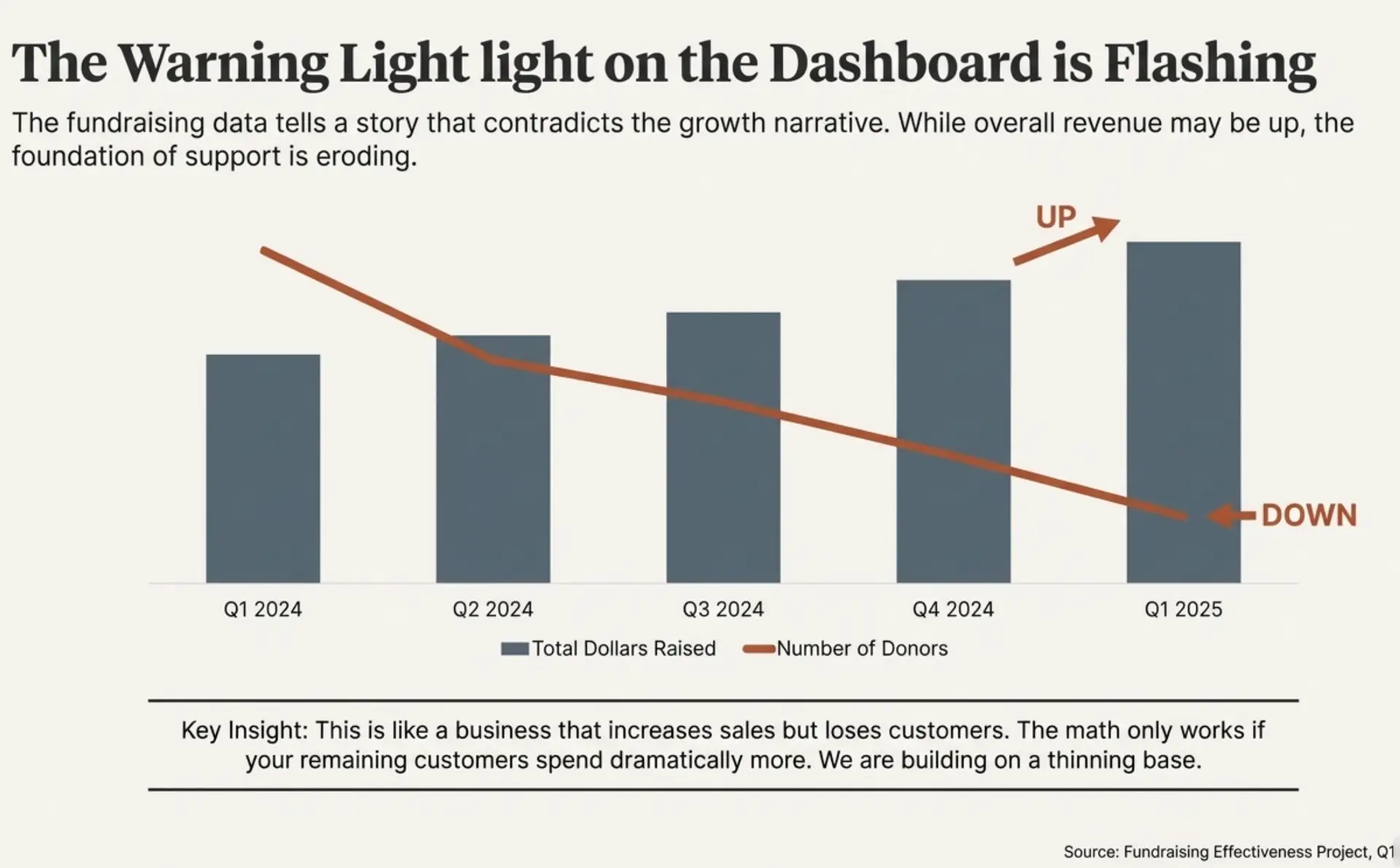
This is not theory. Fundraising data has been flashing the same warning light. The Fundraising Effectiveness Project’s Q1 2025 reporting, shared by the Association of Fundraising Professionals, showed total dollars up while the number of donors declined, with sharp drops among small donors. (Association of Fundraising Professionals, 2025).
Think of it like a business that increases sales but loses customers – the math only works if your remaining customers spend dramatically more. That’s exactly what’s happening – fewer donors are carrying more of the fundraising load, likely meaning wealthy donors are giving larger gifts while grassroots support erodes.
That pattern matters because it tells leaders that while they might have made a campaign and got some dollars, those dollars went away. You can post more, run more campaigns, and still be building on a thinning base. Holding steady is one way to avoid overpromising in light of that reality.
A steadier frame for 2026
If you lead a nonprofit, holding steady might mean reducing commitments and doing them better.
If you run a small business, it might mean choosing margin, delivery, and customer trust over expansion.
In both cases, the work of 2026 looks less like a sprint toward “more” and more like a recommitment to what is already working:
Education and trust building
People do not stay connected to services, or loyal to businesses, when they feel confused, judged, or misled. Clear education, plain language messaging, and consistent expectations reduce friction and build trust. When a client needed to communicate their mobile food pantry services to immigrant communities, the shift from nonprofit jargon about “food insecurity intervention” to simple, welcoming language made all the difference: “Fresh vegetables from our cultural farm delivered to your neighborhood”. Plain language indicates that services are truly for everyone, not just for people who understand industry jargon.
Retention and follow through
The most meaningful KPI are rarely first contact metrics. They are six months later metrics. They are renewal metrics. They are the quiet measures of consistency that prove you are not just reaching people, you are keeping them connected. At a local soup kitchen, success isn’t measured by how many people walk through the soup kitchen doors on any given day, but by the stability that daily access to food creates. stability that becomes the foundation for people to address other challenges in their lives. These “six months later” stories demonstrate that the work isn’t just emergency relief. It’s a sustained community connection.
Sustainable capacity
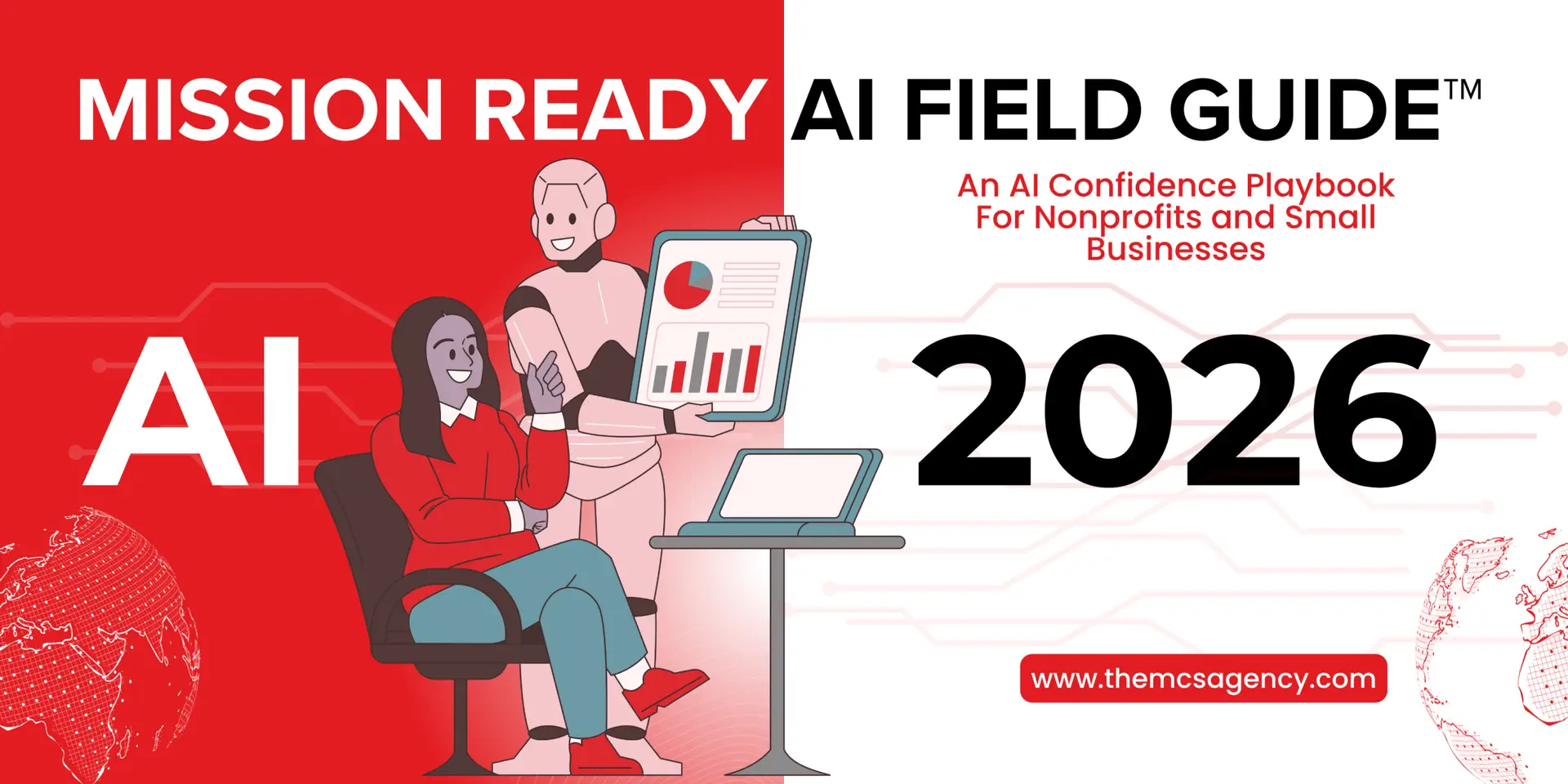
You cannot scale what you cannot sustain. Many organisations need fewer initiatives and better systems: clearer roles, better documentation, realistic workload design, and leadership that is not dependent on one person carrying everything. This is why frameworks like the Mission Ready AI Field Guide™ and the GAP Framework (Google, AI, People) exist not to encourage nonprofits and small businesses to adopt every new tool or launch multiple ambitious campaigns, but to give them a systematic, documented approach to technology adoption that matches their actual capacity. Organizations need processes that don’t leave everything dependent on the institutional knowledge of a single person. They need realistic expectations about what one person can manage. They need fewer initiatives done with better systems.
Practical stability
For nonprofits, stability can mean the support that prevents a crisis from becoming an eminent collapse. For small businesses, stability can mean cash discipline, fewer offerings, tighter operations, and a plan that protects the business through volatility.
In practice, this looks like a marketing consultancy choosing to focus deeply on one core expertise – humanizing AI-generated content and preserving authentic voices rather than chasing every trend or expanding into unrelated services. It looks like maintaining established client relationships that generate consistent revenue instead of constantly pursuing new business. It looks like protecting your business through uncertain times by staying excellent at the specific thing your clients desperately need, not by trying to be everything to everyone and no, we are not talking ABOUT OURSELVES AT ALL!
In a year when costs remain high and uncertainty remains real, holding steady is not settling. It is leadership.
If you're not a subscriber yet, Subscribe NOW.
Digital for the Rest of Us™ is built for nonprofits and small businesses that want to stay visible in a digital-first, AI-driven world. Each issue delivers insights on communications strategy, AI readiness, brand storytelling, and events that shape communities.
Read the latest edition here and other past editions you might have missed
Subscribe to get insights on AI readiness, nonprofit marketing, and community events
Get Digital for the Rest of Us™
One practical question a small team faces, answered in plain language every other week.