
Strategy
Systemize This and Delegate That: How I'm Learning to Grow Without Losing Control
 By Clara MatonhodzePublished

Here's the hard truth about delegation; it's not really about the tasks. It's about letting go of the story that no one else can do it as well as you can.
CLARA MATONHODZE, Founder
You know that moment when you realize your business is actually working, but you’re the bottleneck?
That hit me hard a few months ago. I was juggling the podcast launch for Roots, Routes, and Voices, rewriting a website for a nonprofit doing incredible work, refreshing designs for Operation BackPack4Kids, and developing a new strategy deck for AfriThrive’s cultural farm program. All while managing subcontractors, editing every piece of copy that left The MCS Agency, and drowning in a flood of emails, texts, and – I kid you not – WhatsApp DMs about project revisions.
The work itself? Strong. The clients? Happy. But me? I was running on fumes, realizing that my need to touch everything was the very thing preventing us from growing.
When Control Becomes the Problem
I come from a culture where you show up for people directly, where the personal touch isn’t just lovely—it’s expected. In a previous role, I took pride in the fact that clients would refuse to meet with anyone but me because “I understood them”. I carried that with me. Every client email felt like a conversation I needed to have. Every edit felt like a promise I needed to keep personally.
But that approach doesn’t scale. And more importantly, it was starting to break things.
Clients were sending feedback everywhere – emails, texts, random DMs at 11 PM. It felt responsive and personal, but it was actually chaotic. Tasks were falling through cracks. My team didn’t always know what had been decided or approved. And I was constantly context-switching, which meant I wasn’t doing my best thinking work.
So I did something that felt deeply uncomfortable: I created forms. A client workhub with forms!
Structured intake forms for creative briefs.
Update forms routed directly to the right person through Trello.
A content approval flow that actually flows: Draft → Review → Approval → Publish.
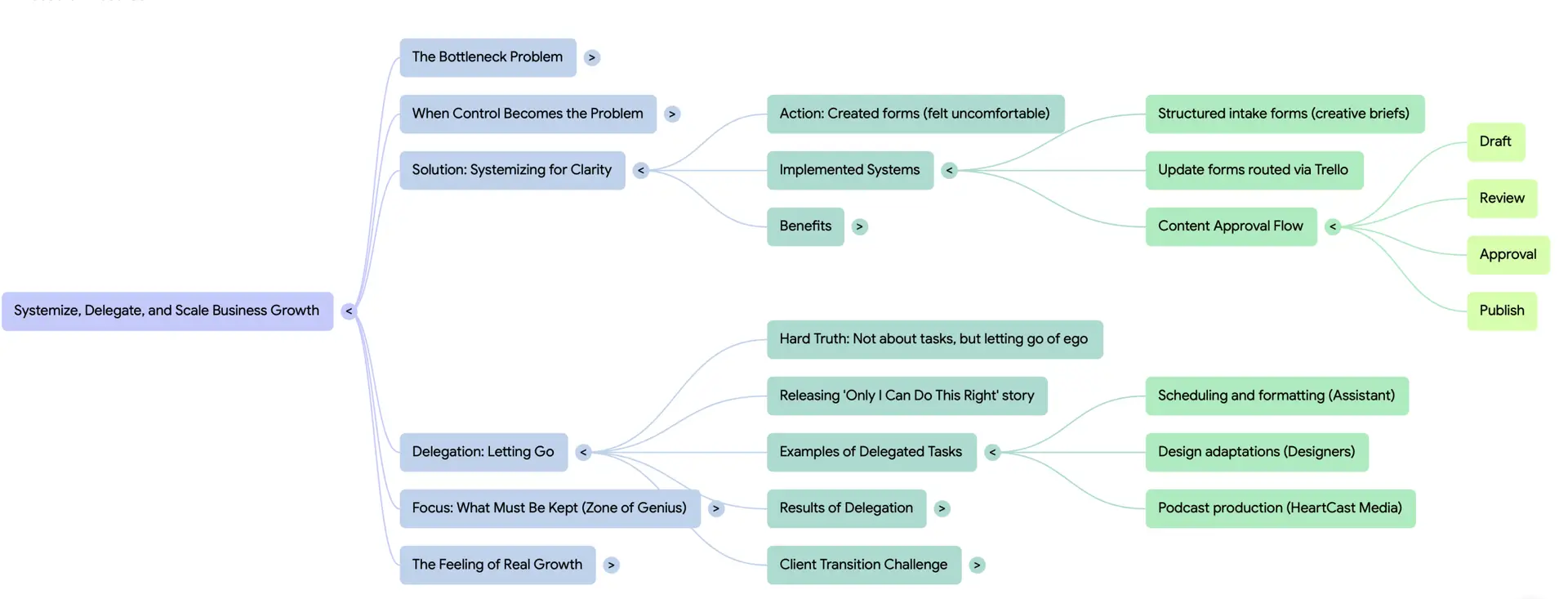
A mind map of the process
No more hunting through old email threads for “one last change.”
That one shift has cut my email load in half. More importantly, it created clarity for everyone, not just me.
Letting Go of “Only I Can Do This Right”
Here’s the hard truth about delegation: it’s not really about the tasks. It’s about letting go of the story that no one else can do it as well as you can.
I used to edit every single newsletter, every caption, every line of website copy myself, partly because I care deeply about the work of these organizations doing life-changing things, from advocating for sustainable urban farming to getting emergency backpacks to kids who’ve lost everything. But also? Because I thought my personal involvement was what made it good.
Now my assistant manages scheduling and formatting. Designers handle adaptations. HeartCast Media produces the podcast so I can focus on the conversations and storytelling – the parts that actually need my voice. And you know what? The work is still excellent IMO. Sometimes it’s even better, because people are working in their zones of genius instead of waiting for me to become the bottleneck.
Some clients still struggle with the transition. They were used to hearing from me directly on everything. One even said, “I thought you’d be the one doing this.” That stings a little. But part of growing a business is teaching clients to trust your systems as much as they trust you.
Now, when someone emails me a quick change request, I reply kindly: “Please use the revision form because it’ll get to the right person faster and nothing will get lost.” That slight redirection says everything about where we’re heading.
What I’ll Never Let Go
There are things I will never systematize or delegate: Vision. Voice. Strategy. The initial conversations where we figure out what a client really needs, not just what they think they want.
That’s also where I bring the most value: helping nonprofits and small businesses tell stories that actually matter, move people, and create change. Whether it’s framing a narrative for an organization working with low-income families or positioning a small nonprofit for major funding, that strategic storytelling work is mine.
Everything else? It belongs in a system or on someone else’s plate.
Growth Feels Different Than I Expected
I’m still learning this. Some days, I catch myself rewriting things I should just review or jumping into an email thread when I should let my team handle it. Old habits die hard!
But every time I successfully systemize something or delegate a task that once drained my energy, I feel the shift. Less white-knuckling. More breathing room. Less chaos at 9 PM. More space to think creatively during the day.
That’s what real growth feels like for me right now. Not just revenue or team size, but reclaiming my time for the work that only I can do. The work that lights me up. The work that shapes what comes next.
If you’re in that same place where your success is starting to trap you- this may be your permission slip. Systemize what’s taking your energy. Delegate what’s outside your genius zone. And keep your best thinking for the work that matters most.
That’s the only way forward that doesn’t end in burnout.
Download the Worksheet - Systemize THIS, Delegate THAT Here.
If you're not a subscriber yet, Subscribe NOW.
Digital for the Rest of Us™ is built for nonprofits and small businesses that want to stay visible in a digital-first, AI-driven world. Each issue delivers insights on communications strategy, AI readiness, brand storytelling, and events that shape communities.
Read the latest edition here and other past editions you might have missed
Subscribe to get insights on AI readiness, nonprofit marketing, and community events
Get Digital for the Rest of Us™
One practical question a small team faces, answered in plain language every other week.